Monday, 15 October 2012

Wonga

Wonga faces questions over borrowing by children


Wonga, the online loans company, is facing questions about whether its checks to prevent children from borrowing cash are adequate following evidence that it has allowed under 18s to build up debts.
Wonga faces questions over borrowing by children


Wonga has faced widespread criticism over its interest rates, allegedly heavy-handed debt collection methods

By Jason Lewis, Investigations Editor8:00AM BST 14 Oct 2012175 Comments

It is the high-interest loans company which came from nowhere to become one of the fastest growing finance firms in Britain.

Wonga has faced widespread criticism over its interest rates, allegedly heavy-handed debt collection methods and, most recently, its £24 million shirt sponsorship deal Newcastle United football club, which some say will tempt impressionable young fans to get into debt.

Now Wonga.com is facing new concerns over evidence it has allowed children to borrow cash, getting themselves, their family, and friends into debt, because its checks to prevent them applying are an inadequate.

Under-18s are banned from taking out loans with the firm, and Wonga dismisses it as "fraud", but a Sunday Telegraph investigation suggests that young people are finding ways to convince Wonga’s "automated, real-time risk and decision system" that they are eligible for its 4,214 per cent APR loans.

The evidence includes:

* Cases of children who lied about their age and successfully applied for loans, building up large debts that they could not afford to repay;

* A debt relief charity says it detects a "worrying trend" with a growing number of children contacting them for help after asking 18-year old friends to take out short term loans on their behalf and then being unable to repay them;

* An MP is preparing a dossier of vulnerable young adults with learning difficulties and mental health issues who have got into debt with the firm.

Critics of Wonga, which earlier this month revealed net profits of £45.8 million for 2011, say its boast of providing cash to loan applicants within 15 minutes does not allow a sufficient "cooling off" period to think carefully about the loan they are taking out and whether they can afford it.

Wonga’s computer system checks whether applicants have a valid bank account – which can be opened by someone as young as 11 – an email address and a mobile phone number, to which it sends a unique PIN code. It also checks applicant’s addresses, asking for the surname of the "bill holder".

Applicants are also given the option of connecting through their Facebook account. Facebook users must be at least 13. "Connecting with Facebook", says Wonga, "helps us to know you better. This will improve your chances of being approved for a loan."

A leading businesswoman told The Sunday Telegraph that her son, who suffers from attention deficit-hyperactivity disorder (ADHD), ran up a series of debts using Wonga when he was 17.

She said: "He simply lied about his age and was able to borrow hundreds of pounds which he couldn’t afford to pay. Then debt collectors hired by Wonga came to us for the money plus interest."

Another parent said Wonga was pursuing them over loans taken out by their 17-year-old daughter on behalf of a friend, also 17. He said they did not find out until "Wonga emptied the bank account (she) uses for her education maintenance allowance and is now unable to get to college".

Wonga was set up by Israeli businessman Errol Damelin, 43, and South African Jonty Hurwitz, also 43, who helped design a mathematical model to allow the firm to issue the maximum number of loans in the shortest time possible at the minimum risk.

Rather than a bank or financial institution, Wonga is a technology firm with Mr Damelin’s ambition for it to be "world class", "like Facebook, Amazon and Apple".

The pair set up the firm in 2007, with Mr Damelin relying on his wife, Julie Blane, a marketing consultant, to cover the bills at their £580,000 East Finchley home while he paid himself just £400 a month as he built the business. By last year one of its directors, thought to be Mr Damelin, was earning £1.6 million.

The business centres on the sophisticated computer program, built by Mr Hurwitz and a team of software engineers.

The partners’ plan was simple, they would borrow from venture capitalists and issue small loans, for up to a month, to customers at a large profit.

They took out a mortgage on their computer model, repaying with an interest rate of between 7 and 12 per cent.

Although Wonga’s cost of borrowing is high – a loan of £400 for a month costs £125.48 in interest and fees – the company claims the traditional APR measure is not relevant to its short term lending.

The business took off, and has now issued more than five million loans, worth up to £1,000 each, with a maximum term of one month.

The business is helped by the lack of legislation in Britain on how much interest can be charged. Other countries, notably Australia and some US states, have placed strict caps on interest rates. Some US states have outlawed loans like Wonga’s completely.

In Britain, television advertising and Facebook marketing helped it go from a loss in 2009 to a strong operating profit.

However earlier this year the firm was criticised by the Office of Fair Trading, which warned it against letters or emails suggesting that customers may have committed fraud and telling them that Wonga would consider contacting the police.

A spokesman for the charity the Debt Advice Foundation said young people were contacting its advice line worried that they owe money to an older friend who had taken out a loan with payday companies, including Wonga, on their behalf and now finding they could not repay the debt.

She said it was evidence of a "worrying" culture change.

Stella Creasy, a Labour MP campaigning for tighter regulation of payday loans, said her office was compiling a dossier of young people who, though old enough to apply for credit, were not capable of making informed decisions and were getting into financial difficulties with the easy credit offered.

Mr Hurwitz now devotes more time to sculpture, a website of his ideas, which he calls "Binge Thinking", and a foundation for child refugees. He has a £2 million home in Haslemere, Surrey, with his wife, Oonagh.

Mr Damelin said careful checks were made to stop children obtaining loans. He said: "If somebody is using fraudulent information to get cash, and then not paying back, they are not the victim – we are the victim."

A Wonga spokesman said: "Like all online businesses, we are not 100 per cent immune to fraud, but it constitutes less than 0.1 per cent of all loans approved and we decline the majority of applications based on creditworthiness or ID-related issues."

She added that in cases of vulnerable adults getting into debt with the firm it had a "hardship team" to "manage these situations as sensitively and swiftly as possible".

Andrew Mitchell

Britain under pressure to end all aid to Rwandan government


Britain is under mounting international pressure to stop all aid to the Rwandan government.
Paul Kagame, the Rwandan president, with Andrew Mitchell in his role as International Development Secretary
Rwanda's President Paul Kagame, Britain's Minister for International Development Andrew Mitchell and Uganda's President Yoweri Museveni talk in Kigali Photo: REUTERS


By Jason Lewis, Investigations Editor 06 Oct 2012

The United Nations and the European Union wants the UK to withhold millions of pounds it is due to hand to President Paul Kagame's government as part of an international campaign to choke his regime of funds.

Rwanda is accused of arming rebels responsible for atrocities, including mass rape, in the neighbouring Democrat Republic of Congo.

They hope that Britain will fall in line after David Cameron replaced Andrew Mitchell as international development secretary in his Cabinet reshuffle last month.

Britain initially agreed to go along with international condemnation of Rwandan involvement and to cancel £83 million it gives it in aid each year.

But Mr Mitchell's last act in the job, before he was moved to the role of Chief Whip, had been to restore about £8m aid to the regime, with another £8m to follow later this year, apparently against the advice of officials in his department and from the Foreign Office.

He based the decision on personal assurances from the Rwandan president and on his own experiences running a small Conservative "charity" project in the country.

Officials were told his personal experience with Project Umubano outweighed evidence from a group of experts from the UN, Human Rights Watch observers and Foreign Office officials.

The Sunday Telegraph has learned that the UN and EU privately expressed their "disappointment" with Mr Mitchell's decision at a hastily convened international contact group meeting at the Foreign Office last month.

A source at the meeting said there were "obvious differences" between Foreign Office officials and "between different officials in the Department for International Development".

Mr Mitchell apparently also ignored police intelligence reports that suggest Rwandan dissidents living in exile in Britain are being targeted by the regime.

Last year the Metropolitan Police took the unusual step of issuing the Rwandan exiles with formal warning notices stating that "the Rwandan government poses an imminent threat to your life".

The United Nations and Europe have both accused President Kagame of giving support and weapons to the so-called 23 March Movement (known as M23) in the Democrat Republic of Congo, accusing it of attacking civilians and "acts of sexual violence".

At a meeting at the UN in New York last week the EU directly accused Rwanda of backing the M23 rebels. President Kagame and senior figures in his regime may now face sanctions over their links to the group and human rights abuses it has carried out.

Two new confidential reports on Rwanda's involvement with the M23 rebels were presented to Security Council officials last week and are likely to lead to further action being taken against the regime at the UN in the next few weeks.

A UN source said: "Britain's position has come as a bit of a disappointment to those who are trying to alter the position on the ground. Everyone else is united in putting pressure on Rwanda."

Britain is Rwanda's largest aid contributor and the source said its involvement in bring pressure to bear on President Kagame was "vitally important".

Internal documents from DfID, released under the Freedlom of Information Act, reveal that in a February 2011 telephone conversation, Mr Mitchell had promised the Rwandan president that Britain would increase its aid from £60m to £90m by 2015. Two months earlier, he had flown to Rwanda for a "90-minute tete-a-tete followed by lunch" with the newly re-elected president.

But the memos also reveal doubts within the department about the "political risk" in Rwanda. Mr Mitchell's ministerial colleague, Stephen O'Brien, highlighted international concern about human rights in Rwanda.

Justine Greening, the new International Development Secretary, must now decide whether Rwanda should receive the second tranche of the money promised by Mr Mitchell. Her office did not respond to requests for comment.

A DFID spokesperson said: "The Secretary of State will consider the issue of budget support to Rwanda carefully before our next decision in December."

It is understood that Mr Mitchell based his decision to continue aiding Rwanda on "personal assurances" from Mr Kagame who had previously attended the Conservative conference and lavished praise on Project Umubano calling it an "unprecedented" example of aid. He is also understood to claim, though, that the decision was later agreed by Downing Street.

The Conservatives' Rwanda project was Mr Mitchell's personal brainchild but was designed to show the caring side of Mr Cameron's Party when it was in opposition.

Now also working in Sierra Leone, the project has seen more than 200 Tory supporters, including Mr Mitchell, his wife Sharon and their daughter Rosie, fly to Rwanda for two-week stints to help as the country slowly recovers from the genocide which saw an estimated 800,000 people murdered there in 1994.

Mrs Mitchell, a GP, has also spent several months working as a doctor in Rwanda.

The Prime Minister praised the project as "the first time that any British political party had engaged in a social action project in the developing world".

He said he and Mr Mitchell had set it up "to raise awareness of global poverty and play a small part in tackling it on the front line".

Yesterday a Conservative spokeswoman said the project, which includes an annual Tories versus locals cricket match, had "provided English lessons to over 3,000 Rwandan primary school teachers, renovated a school, established a small medical library and built a community centre".

Conservative volunteers, including ministers, MPs, Parliamentary candidates and local councillors, pay their own airfares, but much of the start up money for the project came from a wealthy widow from Hove, Helena Frost.

Despite having little interest in politics, according to her family, Mr Mitchell personally persuaded Mrs Frost to provide the funding. Electoral Commission files show that before her death last November, she gave the party £250,000 in donations - £200,000 of which went to fund Mr Mitchell's office in opposition and £50,000 directly to the Rwanda project.

Last night, Mrs Frost's nephew Mark, who was close to his aunt and often accompanied her to charitable events, said he was "slightly taken aback" that she gave so much.

He said: "It would appear Mr Mitchell (was) very charming and very persuasive. It was quite a large sum which doesn't necessarily seem to fit with the amounts she ordinarily gave to the many other charities she supported.

"She was not one to meddle in politics at all and was convinced the money was going to help the poor. She would have not have given money to politicians for political use or gain, she had understood that she was helping the poor in Rwanda."

He added: "This was a private matter and she was reticent about this particular charitable donation.

"She was a wonderful woman who had a great passion for certain causes and for many people. I can only imagine that this may have been the case on this particular case for her to have contributed such large sums to a single cause."

He said Mr Mitchell had been introduced to her through another charity that he was involved with and to which Mrs Frost, who had a considerable personal fortune and had also set up a £6 million charitable foundation in the name of her late husband Patrick, had contributed large sums.

Tuesday, 2 October 2012

"Beano"

Doting wife loses everything after acting as perfect hostess for fraudster Nicholas 'Beano' Levene


He was the flamboyant and charming stockbroker with a reputed golden touch and she was the perfect hostess, loving wife and doting mother.

Nicholas and Tracey Levene.
Nicholas and Tracey Levene. Photo: Edward Lloyd/Alpha


By Jason Lewis, Investigations Editor and Simon Griver in Tel Aviv
7:00AM BST 30 Sep 2012

Together Nicholas and Tracey Levene befriended multimillionaires who he then persuaded to hand over huge amounts of cash for him to invest.

But in reality “Beano” Levene, nicknamed for his love of the boyhood comic rather than his passion for the high life, was gambling the cash and using it to pay for the couple’s life of luxury.

Levene was running a classic “Ponzi” scheme. Behind the facade, his wealth was built on a fantasy of business acumen and was paid for with other people’s money.

Last week the 48 year-old pleaded guilty to running a £32 million fraud stealing from British investors. He is facing a long prison term. In legal cases in Britain and Israel, a series of victims are trying to salvage the money they entrusted to him.

In fact, it can be disclosed, Israel was a second centre of operations for “Beano”, whose nickname there was “Nick the King”. His life in Britain and Israel ran in parallel: a friend to the wealthy, and lavish in his partying, he made friends who became clients to whom he promised healthy returns.

He offered shares in companies that included HSBC, Royal Bank of Scotland, Imperial Energy and Rio Tinto. He told clients he had access to shares unavailable to ordinary investors, which he would trade at a supposedly huge profit.

In the end it came crashing down because the money he had supposedly been investing had been used for spread betting. Instead of buying shares, he would place his clients’ funds in bets on stock market levels and individual shares.

If the share price went up, Levene would pay his clients returns. But when the price fell, he had to pay the spread betting firms. That meant taking new investments and using those to pay his liabilities.

Eventually, the edifice collapsed, leaving clients including Brian Souter and Ann Gloag — the Stagecoach founders who lost £10 million — out of pocket.

From April 2005, he simply stole his investors’ stakes, faked paperwork, and duped new victims to keep the money coming in. He will be sentenced on Oct 22.

The rise of “Beano” began when he returned from Israel to Britain. His electrician father, Martin, and his mother, Anne, had emigrated from their home in Stanmore, north-west London, when Levene was 15.

He served in the Israeli military and worked as a hotel bell boy, but found his real home in the City. It was the peak of the 1980s boom when he started trading, aged 21. Known for his gift of the gab, he used his North London connections to win clients and kudos from his employers.

With his wife Tracey — the couple have three children — he socialised with Sir Philip Green, the retail tycoon, the Tchenguiz brothers and Richard Caring, owner of Annabel’s, the nightclub, and The Ivy restaurant.

By 2004 he had donated £10,000 to the Conservative Party and claimed Howard Leigh, then treasurer, as a “close friend”, although Mr Leigh later said: “I wouldn’t call us close friends, we didn’t go to each other’s homes.”

As markets rose, his promise of 12 per cent returns earned him a £2 million five-bedroom house in Hertfordshire with a heated outdoor swimming pool and cinema room. In Israel there was a £3.4 million villa in Herzliya, Tel Aviv’s wealthiest district, and a home in Eilat on the Red Sea for his parents. The Saturdays, the girl band, played at the bar mitzvah of Levene’s son Daniel.

However, just as his gambling grew in London, in Israel he was also finding victims, including, it can be disclosed, Daniel Jammer, a multi-millionaire German-born Israeli.

Mr Jammer had been celebrating when he met Levene in 2008. His football club, Maccabi Netanya, had gone top of the Israeli Premier League, and Levene, who had been vice chairman of Leyton Orient, offered to buy a stake in his team.

Levene would later claim to have a gambling addiction after losing £50  million. When he met Mr Jammer, Levene owed huge amounts to spread betting firms. The Levenes became friends with Mr Jammer and his wife, holidaying at the Jammers’ Ibiza villa, with Levene offering to cut his new friend in on a major stock flotation.

Last week Mr Jammer declined to talk to The Sunday Telegraph, but his bitterness at the betrayal is clear in court papers filed in Tel Aviv. The documents show Mr Jammer agreed to give Levene £9 million to buy shares in a German transport company but when the flotation fell through Levene failed to return the cash.

Mr Jammer was convinced Mrs Levene was part of the deception – his legal team claim she convinced Mrs Jammer to get her husband to invest. “From conversations they have since had with another couple from abroad who fell victim to the Levenes’ tricks, it became apparent that Tracey knew well even before the money was passed on to Levene that he would neither invest it nor return it,” the papers claimed. The court heard he “was deep in debt and was not able to pay back many people including family members”.

The Jammers tried to force Tracey Levene to sell the villa in Tel Aviv. It was in Mrs Levene’s name but was heavily mortgaged by her husband. The Israeli court ruled that Mrs Levene was unaware of her husband’s Ponzi scheme, but she still lost her Israeli home to British creditors.

A source at the Israeli accountancy firm Deloitte Brightman Almagor Zohar said Mrs Levene’s villa and the home of Sarah Levene Goffer, his sister, were seized and sold, along with an Eilat apartment registered to Levene’s parents, and home contents detailed as “expensive furniture, paintings, and carpets”.

Last week the Levenes’ home in Hertfordshire was listed with four agents priced at £2 million. Land registry documents show Levene had remortgaged the property in September 2008 and within three months a string of creditors had applied for a share in the proceeds of a future sale.

Pictures of the property show a house lined with family pictures and paintings of horse racing and traditional Jewish scenes. But the family have moved out and much of the contents are expected to be sold to pay something towards Levene’s huge debts.

For Levene, the parties in Britain and Israel are very much over.

Killing in Annecy

Gun in Annecy killing may be connected to the region


The killer in the French Alps murder used a gun which may be closely connected to the region, the Sunday Telegraph has learned.
France shooting: Three victims were shot in the head
Police around the BMW at the scene of the shooting in woods near Chevaline in the French Alps Photo: Daily Telegraph


Harriet Alexander in Annecy and Jason Lewis, Investigations Editor
8:30AM BST 16 Sep 2012

Sources close to the investigation have disclosed that Saad al-Hilli, a British engineer, his wife, mother in law and a French cyclist, were shot with a Luger P08, a highly-distnctive weapon which was standard issue to the Swiss Army.

The disclosure raises the possibility that the killer is connected to the areas as the scene of the crime is less than 40 miles from Switzerland.

It comes as The Sunday Telegraph has learned that the French investigation on the ground is being “scaled back” with many of the 120 officers originally on the case returning to normal duties.

French sources said that by last night only 40 gendarmes remained on the case, with many of the Parisian detectives having returned to their base Rosny-sous-Bois in the capital.

In addition to the French forces, 40 British officers were working on the case in the UK, where the French detectives say they are convinced the cause of the crime will be found. A major forensic search was still under way at the family home in Claygate, Surrey, last night, conducted by British officers.

There was also confusion after reports in France that police are looking for a black Mitsubishi Pajero with British number plates in relation to shooting were denied by officers.

Mr al-Hilli, 50, his wife Ikbal, 47, Suhaila al-Allaf, 74, and Sylvain Mollier, 45, a local cyclist, were shot dead in a car park on a remote road, close to Annecy, in the French Alps. The family was on a camping holiday nearby.

Their daughter Zainab, seven, was shot and pistol whipped but their other daughter, Zeena, four, survived. Both are now being cared for in Britain by relatives.

However questions were raised last night by British experts over the conduct of the inquiry, including whether the crime scene had been properly examined and whether the couple’s two children were being used properly as witnesses.

It is now know that the investigators have concluded the gun involved was a Luger P08 gun, which fires highly distinctive 7.65mm calibre bullets and has a capacity of eight rounds.

Given that there were around 25 bullets fired, and the prosecutor confirmed that only one gun was used, the investigators think that the gunman may have used three magazines.

The origins of the gun will be of huge interest to investigators.

Chevaline, where the murders took place, is just 40 miles from the Swiss city of Geneva. The Luger P08 was standard issue for the Swiss army between 1900 and 1945.

Tens of thousands of weapons and ammunition were handed out to all men of military age, who were ordered to store it in their homes. The Swiss army has always been a conscript force made up of all men of fighting age.

The ammunition, which is 21 mm long, is now rare and is used with very few other weapons. The bullets for the Luger P08 are also all marked with their date of manufacture.

Philip Boyce, an internationally recognised UK firearms expert, said: “The ammunition would either have been stored in a dry place since the 1940s or would have to be specially purchased, and therefore would be easily traced. Most Lugers fire 9mm rounds.

“This sort of weapon, because of the non-standard ammunition, would be quite unusual.”

Last week, Eric Maillaud, the prosecutor for Annecy, confirmed that the weapon was a semi-automatic, firing 7.65mm ammunition. But he refused to go into detail about the type of gun, leading to claims that it was a Skorpion, a Czech-made machine pistol developed in the 1950s for use by security and special forces.

The prosecutor also refused repeatedly to discuss the specifics, but The Sunday Telegraph has learnt that the lethal shots were fired at close range - probably less than three feet away.

The significant development comes as questions were beginning to emerge about the inquiry into the multiple murders.

When local gendarmes arrived they had — as protocol dictated — “frozen” the scene, not touching the car or the corpses, until the forensic specialists arrived from Paris. This meant that the al-Hilli’s four-year-old daughter Zeena endured eight hours cowering beneath the legs of her dead mother before she was found.

Local officials were forced to wait until the Institute for Criminal Investigations for the National Gendarmerie arrived from their base in a Paris suburb.

Rivalries between the gendarmes and the police, a separate force, appear to have prevented them from calling in expertise from the National Institute for Scientific Policing, based near Lyon, only a 90 minute drive away - because that is a police rather than gendarme division.

In Britain detectives and forensic teams would have immediately gone to work, rather than “freezing” the scene.

“From the senior investigators point of view, the crime scene provides the best opportunity for evidence,” said retired Detective Superintendent Robert Bridgestock, who led 26 murder inquiries during a 30 year career at West Yorkshire Police.

“You would order a meticulous examination of the vehicle and the surrounding area. You would seal it off until such time as you had secure every scrap of evidence.

“More often than not there will be something, however small, or insignificant it may seem, that will lead you to him.”

There has also been surprise at the speed with which the forensic examination of the scene ended. Although the day after the murder, the area was still cordoned off, there was no visible tent erected to protect the crime scene from the elements - something that would be standard in Britain, and the family’s burgundy BMW was removed within 24 hours of the shooting.

There was also surprise that on Friday afternoon — 48 hours after the crime had taken place, the road up to the murder scene was reopened.

Tyre marks still visible showed the car reversed at speed, and television pictures showed bloodied pebbles and discarded bullet casings. Broken glass was left on the gravel — whether from this crime or a previous incident — and an ancient car radio, its wires yanked out, was still lying on the bank.

Whether the police performed a detailed “fingertip” search, on their hands and knees in the ravine and across the area, is not known.

Mr Bridgestock said: “It would be unusual to leave anything behind at the crime scene. British officers would remove and retain everything even if it appeared insignificant.”

Seven-year-old Zainab, who was shot and pistol-whipped in the attack, suffering a fractured skull, returned to England on Friday after telling authorities that she had seen “a nasty man”.

Zainaib’s life was saved by British cyclist Brett Martin, a retired RAF pilot, who found her in front of the car and administered first aid before leaving the scene to call emergency services. Her younger sister, although unharmed, has been dismissed as a witness and will not be questioned further. The French investigators insist she saw nothing.

Mr Bridgestock said British detectives would have taken a different approach. He said: “The fact is they are the only living witnesses who were there when the attack took place. It takes time and patience, but they would have seen and heard things no one else could and may provide the vital clue that leads you to the killer.”

French prosecutor Eric Maillaud, who is leading the investigation, said last week that three lines of inquiry were being followed and them as a family conflict over money; Saad al-Hilli’s sensitive work as an aeronautic engineer; and his “Iraqi origins”.

However Mr Bridgestock said: “It is easy for an inquiry to get sidetracked. To follow one theory at the expense of others. It is always a danger and you have to keep an open mind and follow the evidence. You must focus of what the crime scene is telling you. Follow the physical evidence and the witness statements. It is too easy to focus on, for example, one victim. There are four people dead and the target could be any one of them or it could be a random attack and they were just in the wrong place at the wrong time.”

Despite the questions French authorities are resolute that they will solve it.

“We’re determined to crack this,” said one senior French investigator.

“The focus may have shifted to Britain, but the French are set on solving it themselves. We want to see this through.”

Tuesday, 4 September 2012

Children's private records leaked on internet from independent school applications

Sensitive Information about hundreds of children, including details of their behavioural problems, has been leaked on the internet after an alleged cyber attack on a company advising parents about applying for top independent schools.

Children's private records leaked on internet from independent school applications
The database was published on the UK Independent Schools Guide website. After being alerted by this newspaper, Prospects Services shut down the website Photo: Alamy
The security breach led to the publication of 1,367 private records, including the names and addresses of pupils and parents and confidential notes about their children’s personality and school achievements and, in some cases, illnesses and learning difficulties.
Among those who had their family details disclosed were a leading television actor, a pop star and the son of a former Cabinet minister.
The list also includes the families of senior businessmen, bankers, lawyers, Foreign Office officials and senior military personnel.
One of the victims, a prominent businesswoman who used the company to try to find a school for her son, said it was “a terrible breach of privacy”.
“We trusted this firm to try to get help with our son’s education,” she said. “They have totally breached that trust.”
Last week, this newspaper alerted the Information Commissioner’s Office (ICO), which said it was opening an investigation.
The watchdog has the power to begin a criminal prosecution and to fine companies as much as £500,000 for serious breaches of privacy.
The security breach centres around a database of information about clients seeking help getting their children into Britain’s independent schools.
What should have been private information protected by internet security could be viewed using a Google search.
Many families on the database had been looking for advice on which schools were centres of academic, musical or sporting excellence.
Several of the children were already at top public schools and were looking to move to “less formal” or less academically-challenging environments.
The greatest breach of trust surrounds details of the children written by their parents.
Descriptions of the named children include: “His weakness is that he doesn’t keep his mind focused on [what] he is doing … he is distracted very easily.”
Others talk about their children suffering from attention deficit hyperactivity disorder, Asperger’s syndrome, dyslexia and dyspraxia, or reveal children’s special needs such as autism.
The company behind the blunder, Gabbitas, is one of the leading firms in the field, and publishes the Independent Schools Guide. It charges a minimum of £199 an hour for personal advice to parents about the right school for their child.
It also offers private tutoring and guardianship provision for children, careers advice and guidance, and recruitment support or management consultancy to schools.
Gabbitas is owned by outsourcing firm Prospects Services, which has a number of multi-million pound government education contracts, and had a turnover of £77 million last year.
The database was published on the UK Independent Schools Guide website. After being alerted by this newspaper, Prospects Services shut down the website.
The firm has claimed that the information had been available on its website only because it had been the victim of a cyber attack.
It said it was “deeply concerned” about the incident, and it had now secured its website and would be asking police to investigate.
“We apologise unreservedly to any individuals who may be affected,” a spokesman said.
An spokesman for the ICO said: “We are grateful to The Sunday Telegraph for bringing this possible data breach to our attention.
"We will be making inquiries into the circumstances of any potential breach of the Data Protection Act before deciding what action, if any, needs to be taken.”

Monday, 16 July 2012

Rendition

  UK admits it does hold records on secret "Rendition" base


THE Foreign Office has been accused of misleading parliament over the evidence it holds about the use a British airbase in the “extraordinary rendition” of terror suspects.


Abdelhakim Belhadj head of the Tripoli Military Council in the post revolutionary Libyan government


By Jason Lewis, Investigations Editor

The department has previously said that it had no information about whether the British base at Diego Garcia in the Indian Ocean was used as a key staging post for the CIA programme.

Classified documents revealed by the Sunday Telegraph earlier this year showed how British intelligence officials provided key intelligence and support for the transfer of terrorists for interrogation in Libya.

The claims centred on MI6’s role in the rendition of Abdelhakim Belhadj, a leading opponent of Col Muammar Gaddafi and then terrorist suspect, to Tripoli in March 2004, where he faced imprisonment and alleged torture.

Mr Belhadj, who is now a leading candidate in the upcoming elections in Libya, was seized in Bangkok and put on a flight which, according to the CIA flight schedule, was due to refuel in Diego Garcia, a British sovereign territory, before flying to Libya.


Flight Plan: CIA planned to use Diego Garcia airbase
However British security sources insist that the aircraft did not fly via the Indian Ocean island and Parliament was told earlier this year that no records existed about this or any other flight to the island.

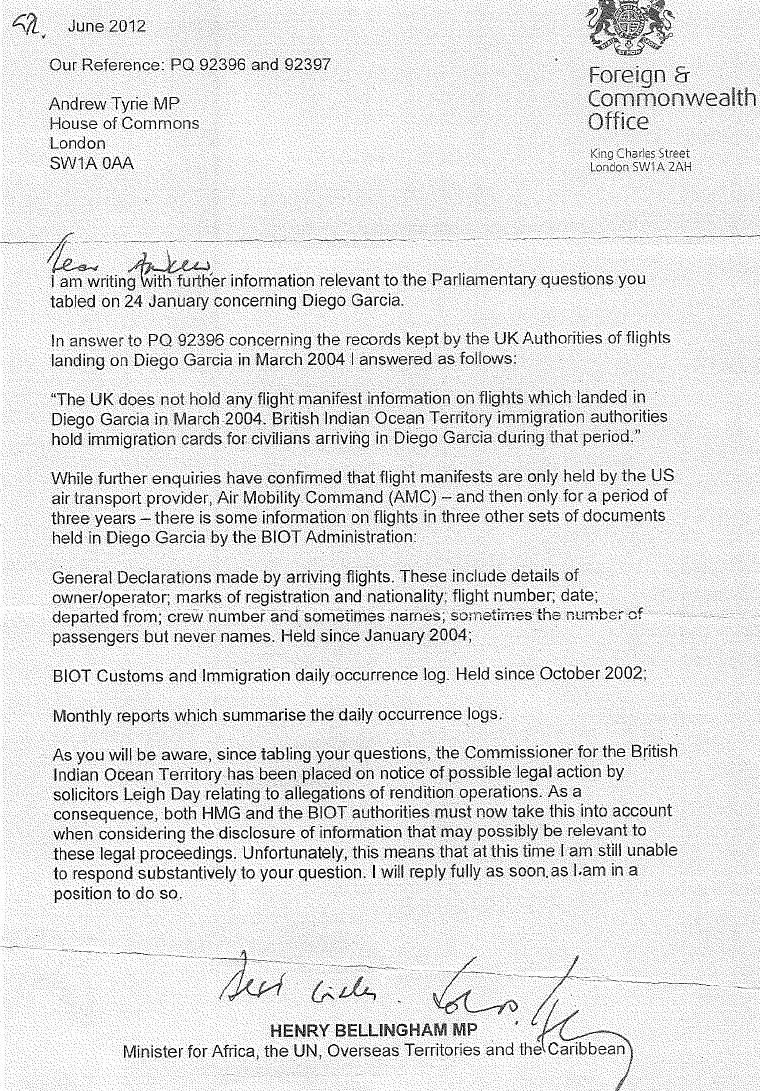
But now, in a letter to Andrew Tyrie, the chairman of the All Party Group on Rendition, who asked for the records in House of Commons questions in January, the Foreign Office has admitted that, despite its earlier claims, records of flights to the island at the time do exist.

The letter from Henry Bellingham, the Foreign Office Minister responsible, confirmed the department had now located “General declarations made by arriving flights.”

He added: “These include details of owner/operator; marks of registration and nationality; flight number; date; departed from; crew numbers and sometimes names; sometimes the number of passengers but never the names.

But Mr Bellingham refused to discuss if detail of the alleged rendition was recorded in this paper work.

He wrote: “As you will be aware, since tabling your questions, the Commissioner for the British Indian Ocean Territory has been placed on notice of possible legal action...relating to allegations of rendition operations.

“Unfortunately, this means that at this time I am still unable to respond substantively to your question.”


http://not4attribution.blogspot.co.uk/2012/02/rendition-did-uk-play-secret-role-new.html

http://not4attribution.blogspot.co.uk/2009/03/binyam-mohamed-mi5-thought-rendition.html

http://not4attribution.blogspot.co.uk/2009/02/binyam-mohamed.html
The letter is the second time Ministers have had to admit they misled Parliament over Britain’s role in rendition.


In 2008 David Miliband, then foreign secretary, told the Commons that Diego Garcia, which campaigners claim was used as a “black site” terrorist detention centre by the Americans, had been used twice during rendition operations. He said both instances had happened in 2002 and without Britain’s knowledge.

He apologised to MPs for incorrect information previously given by his predecessor, Jack Straw, and former Prime Minister Tony Blair, who insisted it had never been used by the flights.

David Lidington, the Europe minister in the current government, reiterated the statement in a parliamentary answer last year.

Last night Andrew Tyrie, said: “Yet again we are in the position of a Minister having to correct what has been said in the past on Britain’s involvement in rendition. It is now time that there was a thorough inquiry into what role Britain played in this.”

The intelligence documents revealed by this newspaper earlier this year appeared to confirm that Britain played an active role in Mr Belhadj’s detention in 2004 and transfer to Gaddafi’s regime.

They suggests the British were the first to alert Libya that Mr Belhadj, who was wanted as head of the Libyan Islamic Fighting Group (LIFG), a terrorist group outlawed by the UN over alleged links to al-Qaeda, was in custody.

It disclosed that Mr Belhadj and his pregnant wife were being held. Four days later, the Libyans were contacted by the CIA who said: “Our service is committed to rendering the terrorist … to your custody.”

Days later another secret memo, sent by the CIA, gave full breakdown of the plan to transfer him to Libya and included details of the flight plan and its scheduled refuelling stop in Diego Garcia.


Rausing

Eva Rausing death: a world of drugs and paranoia in a £70m fortress


The tragic last months of Eva Rausing saw her caught in a spiral of paranoia and despair fuelled by her drug addiction, her friends have disclosed.


Eva and Hans Kristian Rausing in May 2012 (left and right)


Their property in Cadogan Place, Chelsea

By Jason Lewis, Investigations Editor

10:30PM BST 14 Jul 2012

The wife of the Tetra Pak heir, who was found dead of a suspected drug overdose on Tuesday, was tormented by fears that she and her husband, Hans Kristian Rausing, were being spied on at the London home they shared.

She had also come to believe they were being targeted by international criminal gangs in the months before her death.

Her decline has been revealed by the friends she turned to for help in uncovering what she saw as a conspiracy of “bribes, lies and sleaze” against them.

One friend, who has known the couple for more than 20 years, told The Sunday Telegraph how they had turned their £70 million home in London’s Belgravia into a virtual fortress, living in a few upstairs rooms where even their live-in servants were banned from entering.

“Eva said they believed the house was under surveillance and someone who had worked for them and who they trusted was involved. They were really spooked,” the friend said. “She didn’t know what to believe and who to trust.”

Mrs Rausing, 48, was found dead last week following a police search of the couple’s home after her husband was detained for possession of controlled drugs.

An inquest heard that her death was so far unexplained, with investigators awaiting the results of toxicology tests. Mr Rausing, 49, had been arrested on suspicion of murder, but had not yet been questioned as he was being treated for the effects of alcohol withdrawal.

Mrs Rausing’s mother, Nancy Kemeny, 72, said she believed her daughter was killed by a heart condition made worse by flights between London and California for drug treatment.

The friend of the Rausings, who had been in regular touch with the couple over many years, said they last heard from Mrs Rausing at the end of March when she had asked them to keep an eye on Mr Rausing, the son of the billionaire founder of the Tetra-Pak packaging empire.

She told her friend she was planning to “go away for a little while” and asked them to stay in touch with her husband to make sure he was all right while he was on his own. According to the friend, Mrs Rausing had said: “I really appreciate it as I worry about him and we are both very dependent on each other.”

Hans Kristian and Eva Rausing seen in May 2012 (Noble/Draper)

Mrs Rausing, a mother of four, also told her friend: “Things are not going well with Hans’ family ... it is hard to keep going sometimes.” Mr and Mrs Kemeny said their daughter had visited them in the US in April and planned to seek treatment for her addictions, but had returned to England because she was worried about her husband.

The Rausings, who were friends of the Prince of Wales and had given millions of pounds to charity, had become increasingly isolated following a long battle with addiction which saw both cautioned four years ago by Scotland Yard for drug offences.

In 2008, Mrs Rausing, who met her husband at a rehabilitation clinic, was stopped trying to take class A drugs into an event at the US Embassy in London. Heroin and cocaine were later found in a police search of their home.

The Cadogan Place property, which is two town houses knocked into one and linked by underground passageways to two mews properties, was wired to allow the couple to apparently eavesdrop on visitors arriving at their home.

The friend feared for Mrs Rausing and her husband, who had “lost all sense of night and day”. Their few visitors were often asked to come around in the dead of night.

The friend, who spoke on condition of anonymity, said the couple were taking huge amounts of heroin, supplemented by cocaine and prescription painkillers including morphine. “Eva said the doses of morphine would have killed most people,” the friend said.

On one occasion another friend, who also asked not be named, said they had gone to see Mrs Rausing at 11pm earlier this year.

“Eva met me in the kitchen at Cadogan Place,” the friend said. “She confessed it was the first time she had been in the kitchen or the ground floor for several months. Apparently the servants cooked for her and Hans and then left the food on the first floor landing.”

The downstairs of the house is beautifully decorated, and adorned with art, while the basement contains a cinema. But the friend said: “It felt like nobody was home. No one really lived there.”

One of the rear mews houses is used as the Rausings’ garage. The building contains his-and-hers Ferraris, both covered in dust.

In recent months Mrs Rausing’s paranoia and fear had reached new heights. She believed that the couple were being targeted by “very, very bad people”, including people who had “done business in Russia for a very, very long time”. Eva also said she was “terrified”.

The friend said the couple feared former staff members had been paid to spy on them and that their computers and mobile phones were being “hacked”. Last week it was reported that a team of ex-SAS officers working for a security company had been keeping Mrs Rausing under surveillance in an attempt to prevent her from buying drugs.

Another friend said: “One minute Eva would trust you, tell you she loved you, the next she would accuse you of betraying her. She talked of putting a curse on me and said I would 'attract very black energy’. Then next time we spoke she would apologise.”

In more lucid moments Mrs Rausing would acknowledge her own delusions. The friend said: “One day earlier this year Eva said, 'Something is definitely not right in my own mind. Thank you for helping me to see this. I don’t like it but it is good to know that it is internal rather than external.’”

It has been suggested that Mrs Rausing may have been dead for some time. She had not been seen in public since early May and her parents last heard from her via a text message of May 3.

Friday, 13 July 2012

Hans and Eva Rausing. FROM THE ARCHIVE


Prince Charles backs Tetra Pak couple Rausings and declares 'they deserve a second chance'


By JASON LEWIS

UPDATED: 23:39, 9 August 2008


Prince Charles has controversially backed a multi-millionaire heiress caught with large amounts of crack and heroin, insisting she deserves a ‘second chance’.

Prosecutors dropped drug charges against Eva Rausing last month after she admitted possession of crack, heroin and cocaine.

Now Prince Charles is insisting Mrs Rausing should not be sacked from the board of one of his charities despite legal rules requiring trustees to be of good character.

Tetra Pak
Tetra Pak heir Hans Kristian Rausing and his American-born wife Eva, who was caught trying to smuggle crack and heroin into the American embassy


Mrs Rausing was caught trying to smuggle drugs into a function at the American Embassy in London.


She and her husband Hans, heir to the multi-billion-pound Tetra Pak drinks carton empire, were given a conditional caution after more drugs were found at their £10million mansion in exclusive Cadogan Place, Central London.

The decision not to prosecute them has been widely criticised and now Prince Charles, who in 2004 personally appointed Mrs Rausing as a trustee of his charity, the Prince’s Foundation for the Built Environment, insists he wants her to continue.

Yesterday an aide to the Prince said: ‘The Prince’s charities work with young people, many of whom have had problems with drugs.


Charles
Tetra Pak heir Hans Kristian Rausing and his American-born wife Eva, who was caught trying to smuggle crack and heroin into the American embassy


‘They aim to give these people a second chance to help them rebuild their lives. It would therefore be hypocritical for the Prince not to give Eva Rausing a second chance.’

Last night the Prince’s Foundation confirmed it was backing the disgraced multi-millionairess.

Chief executive Hank Dittmar, a former adviser to President Clinton, said: ‘We support Eva Rausing in her efforts to overcome her problems and look forward to her completion of her treatment programme.

'She remains a dedicated member of the Foundation board of trustees contributing to the charity’s education work.’

A spokeswoman for the Prince at Clarence House confirmed that he was ‘backing the

charity’s decision’.

But last night Labour MP Ian Davidson attacked Prince Charles’s support for the Rausings.

He said: ‘There is every difference between a mature adult being involved in cocaine abuse and impoverished youngsters getting involved with drugs.


‘Prince Charles’s stance strengthens the view that the casual use of drugs by members of society and the Establishment is acceptable and that when they are caught they face no consequences.’

 
The Foundation is particularly close to Prince Charles’s heart. It promotes environmentally friendly architecture and design, and is the force behind Poundbury, his model town in Dorset.

Other objectives include improvements in public health and ‘safer streets’.

But the decision to allow Eva Rausing to stay on its board of trustees is a controversial one.

According to the Charity Commission, ‘trustees of charities working with children or vulnerable adults should also make additional, more detailed checks . . . to ensure both that the person they wish to appoint as a trustee is eligible and to ensure the safety of the charity’s beneficiaries’.

The controversy comes after the Crown Prosecution Service agreed to drop the prosecution of the Rausings in return for the couple admitting their guilt and agreeing to a strict treatment regime and regular drugs tests.

Conditional cautions were issued to the couple last week after correspondence between the CPS and the Rausings’ lawyers.

Typically, addicts caught with similar quantities of drugs face a prison sentence.

A ‘conditional caution’ differs from a simple caution in that the offender must comply with certain conditions to receive the caution and to avoid prosecution for the offence they have committed.

Mr Rausing stands to inherit the £5.4billion Tetra Pak empire built up by his Swedish father, also named Hans, who also lives in Britain.

The family are said to have the seventh-largest fortune in Britain.

The Rausings’ properties include a £50million estate in Barbados and a 3,000-acre retreat in East Sussex.

Mr and Mrs Rausing have contributed huge sums to addiction charities, and Mr Rausing was long believed to have dabbled in drugs.

But only after Mrs Rausing’s arrest did it become public that both were addicted to crack and heroin.

Monday, 9 July 2012

Banking crisis

RBS fights to keep its Libor records secret


Royal Bank of Scotland is fighting a court order requiring it to co-operate with an international criminal investigation into allegations its staff fixed a key banking lending rate.

The move represents a potential political embarrassment with George Osborne, the Chancellor, potentially facing questions over why a bank ultimately controlled by the Treasury, is attempting to resist international law enforcement investigations into the practice


By Jason Lewis, Investigations Editor, and Glenn Johnson in Ottawa

7:00AM BST 08 Jul 201243
RBS, the partly-nationalised bank, is one of a number of institutions being investigated for possible rigging of Libor, the inter-bank interest rate, a probe which last week saw high street rivals Barclays fined £290m and Bob Diamond, its chief executive, forced to resign.

Now it can be revealed that RBS is battling a court ruling to hand over confidential internal documents which could contain evidence that its traders were also actively involved in the manipulation of the inter bank rate.

RBS has been resisting for more than a year investigators pursuing documents which allegedly detail wrongdoing by its staff.

The move represents a potential political embarrassment with George Osborne, the Chancellor, potentially facing questions over why a bank ultimately controlled by the Treasury, is attempting to resist international law enforcement investigations into the practice.

Asenior Canadian judge has ordered the bank, and several of its rivals to hand over evidence to investigators from the Canadian Competition Bureau, a law enforcement agency which protects the country’s business and money markets from fraud.

The court order was issued after a whistleblower revealed how a group of international bankers based in London had manipulated the Libor governing inter bank lending in Yen, the Japanese currency.

The papers suggest that the group used emails and instant messaging to communicate artificially high or low bids, but RBS, apparently alone among the banks under investigation, has instructed its lawyers to fight the order to release these files.

Court papers name eight London-based bankers based on the testimony of a former colleague working for a rival bank.

Both the unnamed witness, known in the documents as “Trader A”, and his employers, believed to be Swiss bank UBS, have been granted immunity from prosecution in return for their testimony.

In all the Canadian case, which has not yet filed charges against any of the banks or individuals, has named six banks as being involved in fixing the Yen Libor rate.

As well as RBS, the papers feature claims against London-based bankers from HSBC, Citigroup, Deutsche Bank, JP Morgan and UBS.

RBS is the only bank involved in the Canadian court challenge, according to the court documents.

The Libor affair, described by the prime minister as a scandal, has led to the resignation of three of Barclays’ most senior executives, including chief executive Bob Diamond.

According to the court papers t Canada’s Competition Bureau is examining whether the bankers “conspired to enhance unreasonably the price of interest rate derivatives from 2007 to March 11, 2010 … conspired to prevent or lessen, unduly, competition in the purchase, sale, or supply of interest rate derivatives”.

An affidavit from Brian Elliott, a competition law officer, named two senior RBS interest rate differential traders, Brent Davies and Will Hall, both based in London, who he said were involved in the attempts to manipulate the Libor rate.

He told the court “both were registered by the Royal Bank of Scotland PLC and with the Financial Services Authority during the time of the transactions”.

FSA records show that both men are no longer registered as regulated approved traders.

The other accused bankers include Peter O’Leary, an executive at HSBC, Stuart Wiley and Paul Glands from JP Morgan, and Guillaume Adolph, from Deutsche Bank.

The papers alleged there were agreements to “submit artificially high or artificially low Libor submissions in order to impact the Yen Libor interest rates published by the British Bankers Association. This was done for the purpose of adjusting the price of financial instruments that use Yen Libor rates as a basis.”

Mr Elliot told the Court: “The Royal Bank of Scotland Group PLC...are believed to possess documents related to the investigation under way into the Yen Libor inquiry and have employees involved in the alleged offences.”

But earlier this year RBS, through its Canadian subsidiary, filed papers objecting to the court order to produce the evidence the Competition Bureau requested and asked the court to quash an order requiring it to comply.

RBS’s Canadian lawyers told the court the bank should not be required to produce confidential records under Canada’s Competition Act, claiming part of the law violated the constitution of Canada.

Royal Bank of Scotland (Canada) was ordered early in 2011 to hand over records related to any trading of Yen Libor. But in court documents, Canadian employees of the bank maintain the records are under the control of UK bank officials and that the Canadians do not have access to any of those records.

A lawyer for the bank has asked the court to quash the order to turn over financial records, claiming they are protected under British privacy laws.

In a letter to the court, lawyers for RBS also asked for assurances that any records obtained in Canada would not be used against the Canadian arm of the bank in any future criminal investigations. Public prosecutors refused to give those assurances.

Last night a spokesman for RBS said: "RBS is cooperating with regulators in their investigations. We want to cooperate with the CCB and have proposed ways to do that which allow us to comply with our English legal obligations."

Monday, 18 June 2012

Warsi

Baroness Warsi, her extremist business partner and the lunch with the Prime Minister


Baroness Warsi, the Conservative chairman, was facing questions last night over whether she breached the ministerial code by promoting her private business at a party function.

ACCESS: Baroness Warsi's business partner Abid Hussain met the Prime Minister

By Jason Lewis, Investigations Editor
9:00PM BST 16 Jun 2012

She personally paid for potential customers, one of whom was in negotiations over a deal with her firm, to attend a Conservative Party lunch with the Prime Minister last month.

The Sunday Telegraph has also learnt that her business partner, Abid Hussain, a former activist with a radical Islamic group who has a conviction for violence, secured an invitation to meet David Cameron at Downing Street, raising questions over the Prime Minister’s security.

The disclosures put Lady Warsi under fresh scrutiny.

Mr Cameron has already asked Sir Alex Allan, the independent adviser on ministerial conduct, to investigate after The Sunday Telegraph disclosed that she had not declared a majority stake in Rupert’s Recipes, a restaurant supply firm whose other shareholder is Mr Hussain.

However the disclosure that she apparently used a political function to promote her business appears to breach clause one of the Ministerial Code, which states: “Ministers must ensure that no conflict arises, or appears to arise, between their public duties and their private interests.”

Last night Labour said it would table further questions on Lady Warsi’s conduct. Michael Dugher, the shadow Cabinet Office minister, said: “These latest allegations take the scandal to David Cameron’s doorstep and to the heart of Downing Street.

“The Conservative Party chairman seems to have been giving her private business associate – a man who has admitted being involved in an extremist Islamist group – access to the corridors of power.”

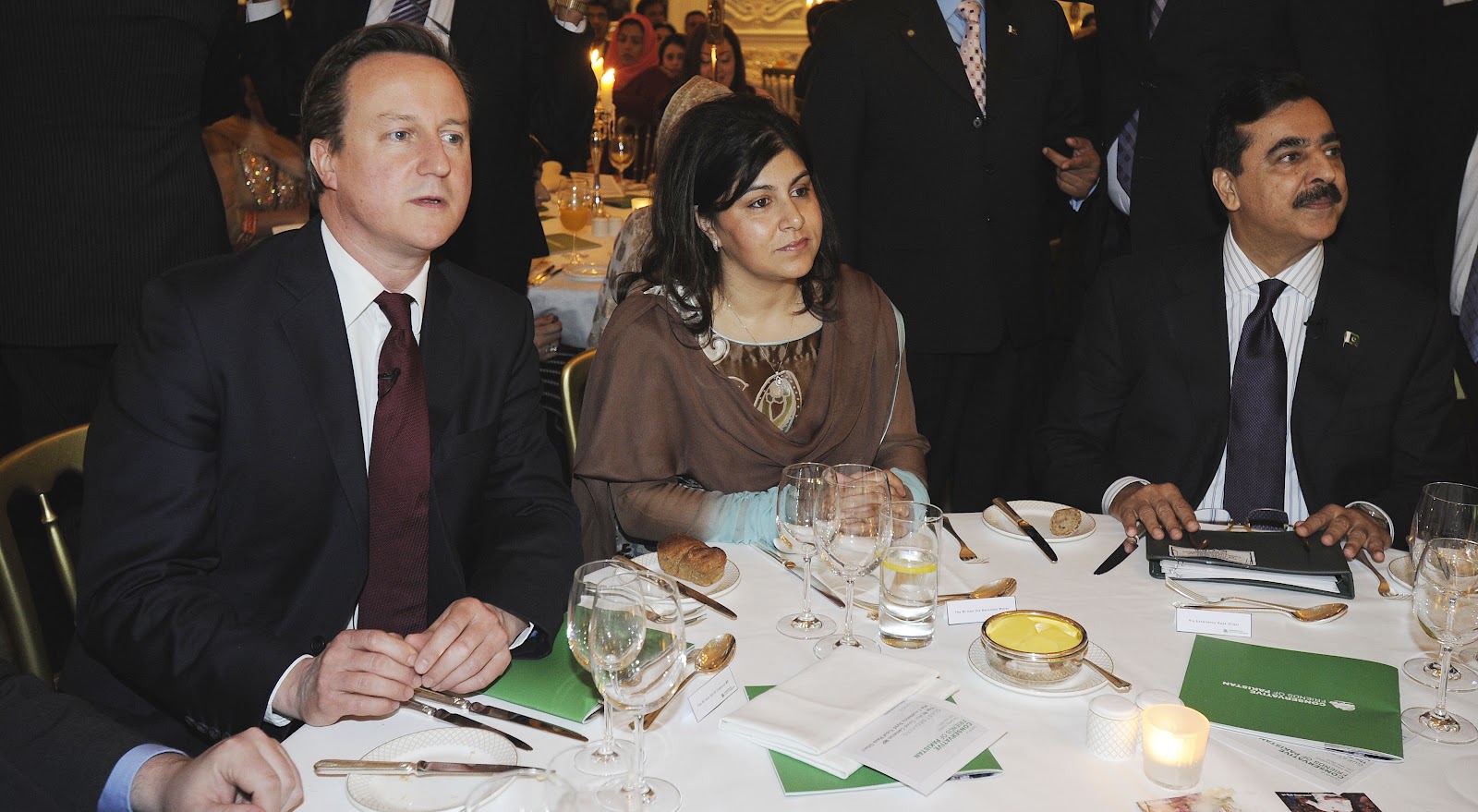
The latest revelations concern the launch of the Conservative Friends of Pakistan, in the Savoy Hotel, central London, last month. The guests of honour were Mr Cameron and Yousuf Raza Gilani, the Pakistani prime minister.

Lady Warsi paid a total of £5,000 for two tables at the event. Guests on one table included her parents, sisters, and others involved in the family’s Dewsbury-based bed manufacturing business.

She “hosted” another table, made up of clients and staff from “Rupert’s Recipes”, although she sat on the VIP table.

The guests’ names were supplied to the Conservative Party by Lady Warsi’s husband, Iftikhar Azam, from his Rupert’s Recipes email address. Rupert’s Recipes describes itself as a “one stop shop for bespoke ingredients” for breaded chicken, fish batter, meat marinades and kebab seasoning.

As well as Mr Azam, the table included Mr Hussain, Mohammed Johngir Saddiq, and Fareed Nasir. Mr Nasir is the founder of Chunky Chicken, a chain of 19 fast food restaurants, mainly in the Midlands and North West. He said he was invited to the event by Mr Azam as they were “working closely” about a possible deal.

“We are trying to do some work with Rupert’s Recipes, we are not using their spices at the moment but we have had some samples,” he said. He added that he is not a member of the Conservative Party and has not donated money. Mr Saddiq runs Big John’s, a chain of 15 takeaway shops in and around Birmingham, worth £19.5 million. His business claims to have been the country’s first “drive thru” fish and chip shop and offers “the nation’s biggest pizza”. He declined to comment on the function.

Other guests included a halal meat supplier, and men believed to be Pakistani restaurateurs.

Lady Warsi personally vouched for the table’s guests, meaning they were exempt from checks carried out by the party’s internal compliance team, which verifies that guests can legitimately make donations to the party.

Labour wants the latest disclosure added to the investigation that is already under way into why Lady Warsi did not disclose that in February this year she owned a 60 per cent stake in Rupert’s Recipes. Peers have to disclose if they are majority shareholders in a company.

The Conservative chairman said that she became a majority shareholder when shares were transferred to her, but “immediately” transferred a proportion to her husband, and therefore did not have to register the holding with the Lords. However, party officials have consistently refused to provide exact details of the share transfer.

There are also questions over Mr Hussain, who met Mr Cameron at a Downing Street reception in November 2010 at which Lady Warsi was also present.

He has been closely involved with the Islamist group Hizb ut Tahrir, which Mr Cameron pledged to ban while in opposition. Mr Hussain, 42, was first involved with the extremists in the early 1990s, and backed them at meetings after the July 7 bombings in 2005. He also has a conviction for an assault, committed when he was 17. His lawyers confirmed that he was convicted of actual bodily harm in 1988 or 1989 and sentenced to three months in a young offenders institution.

They said that the conviction is now “spent” and its disclosure has “no legitimate …public interest”.

However, it would have been relevant to his presence in Downing Street as it raises serious security questions about whether he was fully vetted.

It is unclear whether Lady Warsi, who has said that she knows nothing of Mr Hussain’s involvement with Islamic extremists, played any role in getting him on the guest list.

The latest disclosures come after Lady Warsi admitted she failed to declare rental income on a flat she owns, and is being investigated in the Lords over expenses claims for overnight stays in London. She stayed as a guest of a party donor who says he did not charge her rent. She claims she gave the money to an aide, also living at the address, who had invited her to stay.

Questioned on the Number 10 reception, a Downing Street spokesman said: “All guests invited to Downing Street receptions must go through security checks and are properly searched on entry to ensure they pose no security threat and all electronic equipment, including mobile phones, is taken off them for the duration of their stay.”

He failed to answer questions about whether security would be reviewed in the light of Mr Hussain’s invitation to the event.

A Conservative Party spokesman said of the Savoy reception: “This was a party event organised by the Conservative Friends of Pakistan to reach out to potential supporters within the British Pakistani community.

“All those who bought tables were fully compliance-checked to ensure they were permissible donors, and everyone who attended was subject to the normal security arrangements.

“No gift or hospitality was received by Baroness Warsi and no issue arises in relation to the ministerial code.”

He added: “This was a party-political event for members of the British Pakistani community. To suggest that there was any impropriety in their being invited is simply mischief-making.”

Warsi

Baroness Warsi and the 'extremist' who went to Downing Street


A man who had once been a prominent activist in Hizb ut Tahrir, a group which wants Britain to be run under stritct Islamic law, shook hands with David Cameron in the drawing room of 10 Downing Street.


Abid Hussain meets David Cameron at No 10


By Jason Lewis, Investigations Editor
7:00AM BST 17 Jun 2012

It was a moment that, for Abid Hussain, must live long in the memory.

He was standing in the drawing room of No10 shaking the hand of the Prime Minister.

It was an extraordinary turn of events for a man who had once been a prominent activist in Hizb ut Tahrir, a group which wants to overthrow Britain’s democracy and replace it with a state run under strict Islamic law.

He was introduced to David Cameron at an event to celebrate the festival of Eid which had been organised by Downing Street with the help of Baroness Warsi, the Conservative Party co-chairman, and her office.

Whether it was the Cabinet minister who put his name on the guest list for the event in November 2010 is unclear, but what was not known at the time was that Mr Hussain was actually Lady Warsi’s business partner: they are the joint owners of a company.

Mr Hussain, a second cousin of Lady Warsi’s husband, had also recently returned from Pakistan where he “assisted” her and the British high commissioner on a ministerial visit.

There are now questions about whether Downing Street knew two other facts about the man given access to the Prime Minister and the heart of government: firstly, that he was involved in an extremist group that Mr Cameron had pledged to ban, and secondly that he has a conviction for a violent assault during his younger days in Sheffield.

Whatever the answers to those questions, Mr Hussain attended another reception with Mr Cameron last month, when Lady Warsi invited him to the launch of the Conservative Friends of Pakistan, a party interest group designed to foster better understanding with the Asian nation and the huge Pakistani community in Britain.


He was also present at a lunch organised by Baroness Warsi, who sat at the top table with the Prime Minister 

Lady Warsi paid for Mr Hussain and her husband, Iftikhar Azam, to bring a group of business contacts of their firm, Rupert’s Recipes, to the fund-raising lunch at the Savoy Hotel in the Strand.

The launch was planned by Lady Warsi with the help of her special adviser Naweed Khan and her personal assistant Gulsum Aytac, who between them had written the Friends of Pakistan group’s mission statement and strategy and drawn up its structure.

The final guest list was a who’s who of wealthy and successful British Pakistanis.

Entrepreneurs, bankers, property developers and diplomats all paid between £2,000 to £5,000 for a table alongside Mr Cameron and Yousuf Raza Gilani, the Pakistani prime minister.

On table 15 were eight guests of Rupert’s Recipes, the Sheffield spice supply business which, company documents published in February show, was 60 per cent owned by Lady Warsi.

Mr Azam sent the names of the guests to Conservative Central Office using his Rupert’s Recipes email account. Lady Warsi sat on the VIP table with Mr Cameron and Mr Gilani.

On the Rupert’s Recipes table was Mr Hussain and Mohammed Johngir Saddiq — “Big John”, the millionaire boss of a chain of Birmingham fish and chip shops bearing his nickname.

The photographers captured a smiling and laughing Mr Saddiq with his arm around Mr Hussain.

Other guests included Fareed Nasir, the owner of Chunky Chicken, a fast food franchise with outlets across the North West, the Midlands, Cardiff and Newcastle upon Tyne, several other Asian restaurateurs and the owner of a leading halal meat wholesaler.

Whether business was discussed as Lady Warsi’s guests enjoyed a three-course lunch, with a vegetarian starter, breaded chicken main course and a kheer rice pudding with ice cream, is not known.

But several of those invited to accept the minister’s hospitality were certainly in a position buy the spices and fried chicken and fish mixes in which Rupert’s Recipes specialises — and Mr Nasir says he was in negotiation to do precisely that.

For Lady Warsi the day was a triumph. She looked relaxed and happy as she stood alongside her husband, and with her mother and father and sisters, who were also invited and sat on a second table paid for by the minister.

She told the gathering that it was “obvious that a modern progressive Conservative Party should reach out to say that our relationship with British Pakistanis should be broader and deeper, that our relationship with Pakistan should be broader and deeper, and that the Conservative Party should become the natural home of many many enterprising Pakistanis”.

In response, Mr Cameron described Lady Warsi as an “extraordinary political talent”, thanking guests for coming to an event at which, he said, “the majority of the Cabinet” were present.

He added: “I am proud that I am the first British prime minister to have a Muslim woman in my Cabinet.”

But by mixing business with politics, by failing to declare her business activities, and by allying herself with a business partner with a dubious past, Lady Warsi may have put that place in history in doubt.

Monday, 11 June 2012

Warsi

Baroness Warsi and the 'extremist'


Baroness Warsi, the Conservative Party chairman, faces fresh questions over her business partner.

ACTIVIST: Baroness Warsi's business partner Abid Hussain at a Hizb ut Tahrir rally in 1995

By Jason Lewis, Investigations Editor9:00PM BST 09 Jun 2012

The peer is under investigation over her undeclared links to Abid Hussain, a relative by marriage with whom she is involved in a catering business.

However, there were calls last week for the inquiry, ordered by David Cameron, the Prime Minister, to be widened after Mr Hussain admitted that he had been involved in Hizb ut-Tahrir, a radical Islamist party that the Conservatives had pledged to ban.

In his first public statement, Mr Hussain said that he had attended its meetings, although he said he had never been a “member”, and had not told Lady Warsi about his involvement.

She has previously said she was unaware of his activities.

There were also questions over one of the trips to Pakistan by Lady Warsi on which she was accompanied by Mr Hussain.

The current investigation into Lady Warsi is being carried out by Sir Alex Allan, the Prime Minister’s adviser on the ministerial code, into the disclosure that company documents showed she was the majority shareholder in Rupert’s Recipes, a spice company whose other shareholder was Mr Hussain


In February last year, she travelled to the country on government business and in the course of the trip opened the “Office for Overseas Pakistanis and British Nationals”, which she said “works with police forces across the UK and British consular services on issues such as forced marriage and kidnapping”.

However, The Sunday Telegraph has established that the office is operated from the premises of an opposition party, whose British arm organised a protest against US policy when President Barack Obama visited Britain.

Last night, Michael Dugher, Labour’s shadow cabinet office minister, said Lady Warsi appeared to be mixing party and government business.

The current investigation into Lady Warsi is being carried out by Sir Alex Allan, the Prime Minister’s adviser on the ministerial code, into the disclosure that company documents showed she was the majority shareholder in Rupert’s Recipes, a spice company whose other shareholder was Mr Hussain.

She had not registered the holding with the House of Lords, whose rules say peers should declare any majority shareholdings.

“These further revelations about the conduct of Baroness Warsi are extremely worrying,” Mr Dugher said.

“Yet again, there seems to be a blurring of the lines between what constitutes proper official business and what is, in fact, party political activity with private associates.

"Labour will be asking urgent questions next week in Parliament, including of the Foreign Office.

"What the baroness was doing with someone who has admitted his involvement with the extremist Islamist group Hizb ut-Tahrir also calls into question her judgment.”

Hizb ut-Tahrir has been accused of promoting racism and anti-Semitism, praising suicide bombers and urging Muslims to kill Jews.

Before coming to power, Mr Cameron pledged to ban it but the plan was shelved after a Coalition review.

The nature of Mr Hussain’s involvement in the radical party has already prompted questions over the extent of security vetting.

He has twice accompanied Lady Warsi on trips to Pakistan, and has also been pictured in the House of Lords at a reception for her.

In the early 1990s, sources say, Mr Hussain joined Hizb ut-Tahrir and was nicknamed “Strapper” by other students because of his bulky frame.

He lived for a time in one of its London houses, studying the radical form of Islam taught by its then leader Omar Bakri Mohammed, who is now banned from Britain.

In 1995, Mr Hussain attended a party rally filmed in a BBC a documentary and was seen laughing and joking with others.

Mr Hussain issued a statement through a lawyer last night which said he “has never been a member of Hizb ut-Tahrir”.

“In his mid-20s, which is to say more than 20 years ago, Mr Hussain attended Hizb ut-Tahrir meetings,” the statement said. “However, he often debated against their views and never became a member.”

A former Hizb ut-Tahrir activist, Ghaffar Hussain, who now works for the Quilliam Foundation, the anti-radicalisation organisation, said: “He [Mr Hussain ]acted as a key recruiter and propagandist for the groups in the late 90s.

“Hizb ut-Tahrir have a very idiosyncratic definition of the term 'member’. Only the very senior and public activists call themselves 'member’.

“This gives the junior activists and those who don’t want to be public about their involvement plausible deniability by claiming that they are not officially 'members’.”

Mr Hussain’s brother is still a high-profile figure in Hizb ut-Tahrir, and is referred to as “Professor” Muhammad Nawaz Khan in videos and photographs on its website.

Mr Hussain said last night he had not spoken to his brother in a decade.

Mr Hussain’s presence on Lady Warsi’s trip in February last year to Lahore was disclosed by the Conservative chairman last week. He was present when she opened the “Office for Overseas Pakistanis and British Nationals”.

The Foreign Office described the organisation last week as a “private initiative” and as a “charity” that “helps British nationals overseas”.


However, The Sunday Telegraph has established that the organisation is run by a political party, the Pakistan Muslim League Nawaz (PML-N), headed by a former Pakistan prime minister, Nawaz Sharif, and his brother, Muhammad Shahbaz Sharif, the chief minister of the Punjab.

It is unclear whether Baroness Warsi knew the organisation appears to be political, rather than charitable. During the Lahore event, attended by Mr Sharif, Mr Hussain and Baroness Warsi were pictured with Anjum Chaudhary, the president of PML-N’s UK Youth Wing.

Mr Chaudhary organised a protest outside Parliament in May last year against President Obama’s state visit.

In the UK, the office, based in the party’s headquarters, in Romford, east London, is headed by the PML-N’s UK president, Zubair Gull, and shares several members of staff.

Abid Hussain appears to be involved in the organisation, appearing in a number of photographs on its website.

A Conservative Party spokesman said: “Sir Alex Allan is looking at Baroness Warsi’s business relationships and will provide advice on how they should be handled in future.

“All relevant information regarding Baroness Warsi’s business interests will be available to Sir Alex.”